

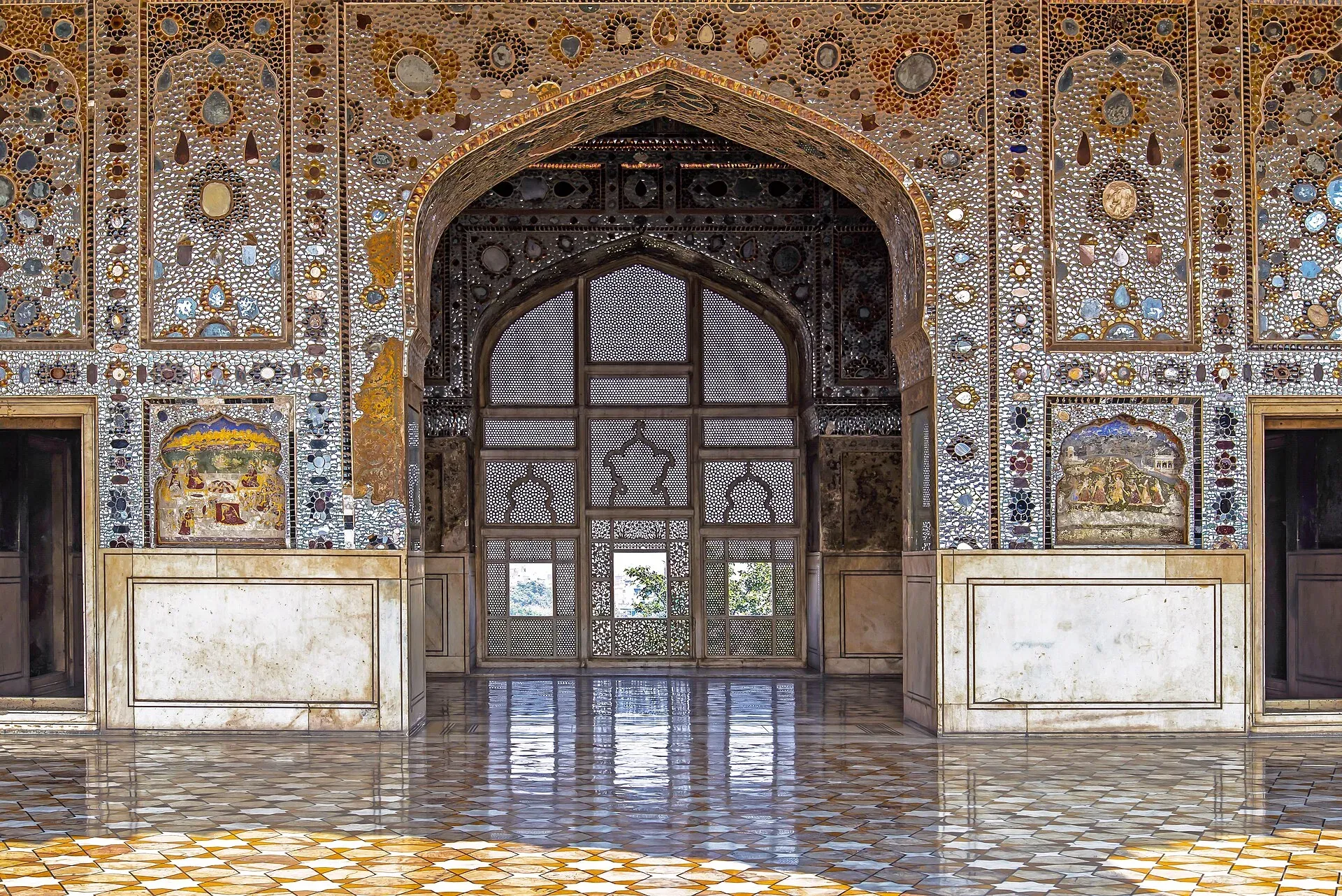
Photo: Faisalrazamalik, with thanks · CC BY-SA 4.0 · via Wikimedia Commons · temporary stand-in photo

Sikh Heritage
A journey through the Sikh holy places of Pakistan: Lahore, Nankana Sahib, Hasan Abdal and Kartarpur. Story, timeline, etiquette, pilgrim quotas and current safety limits.
Customise this route Change the dates, stops and how you travel in the Road Trip Planner.
The story
Sikhism began in the land that is now Pakistan. Guru Nanak, its founder, is believed to have been born at Nankana Sahib, to Mehta Kalu and Mata Tripta. In 2026 the Evacuee Trust Property Board is marking his 557th birth anniversary, which places his birth in 1469. He is said to have reached Hasan Abdal with his companion Bhai Mardana in 1521, where tradition holds that his hand left a print on a boulder. He later settled at Kartarpur, on the Ravi, where he farmed and gathered a community for about 18 years until his death in 1539.
Two centuries later Sikh power shifted to Lahore. Maharaja Ranjit Singh took the city in 1799 and lived in Lahore Fort. He rebuilt the Janam Asthan at Nankana Sahib, and Hari Singh Nalwa is credited with the first gurdwara at Hasan Abdal. Ranjit Singh died on 27 June 1839. His son Kharak Singh began his samadhi beside the fort and Duleep Singh finished it in 1848. The Sikh Empire ended in 1849, when the East India Company took control.
The 20th century added grief and devotion. On 20 February 1921, 86 Sikhs were killed at Nankana Sahib in a clash with the shrine's manager and his supporters. The main Kartarpur shrine was built in 1925 with funds from the Maharaja of Patiala. After 1947 most gurdwaras in Pakistan fell out of use. In 2012 about 16 of roughly 175 were open for worship, and in 2024 the Pakistan Sikh Gurdwara Parbandhak Committee (PSGPC) listed 21 as operating. Many are in Nankana Sahib.
Timeline
- 1469: Guru Nanak's birth at Nankana Sahib (worked out from the 557th anniversary in 2026).
- 1521: Guru Nanak at Hasan Abdal; the Panja Sahib tradition.
- 1539: Guru Nanak dies at Kartarpur.
- 1799: Ranjit Singh takes Lahore.
- 27 June 1839: Ranjit Singh dies; samadhi finished in 1848.
- 1849: The East India Company takes control of Punjab.
- 20 February 1921: Nankana Sahib massacre; 86 Sikhs killed.
- 1925: Kartarpur Sahib built.
- 9 November 2019: Kartarpur Corridor opens for pilgrims from India.
- 7 May 2025: India suspends corridor services; the FCDO still lists the corridor as closed for crossings.
Lahore
The Samadhi of Ranjit Singh, with gilded domes and a marble lotus-shaped urn, stands next to Lahore Fort, the Badshahi Mosque and Gurdwara Dera Sahib, which is also the PSGPC's headquarters. The fort was Ranjit Singh's residence. The fort, the mosque and the samadhi form one compact group, so a morning on foot covers all three; see the Walled City page for the streets around them.
Nankana Sahib
Gurdwara Janam Asthan, the holiest gurdwara in Pakistan for many Sikhs, has a pool, a darbar hall and towers. It is one of nine important gurdwaras in the town. Wikivoyage lists dahi bhalay, gol gappay (hollow crisp shells filled with chickpeas, onion and potato, served with a sour drink), biryani and pulao as local food, and rabri, sugarcane juice and lassi as drinks. The town is on the M-3 and has a railway station on the Lahore line. Langar is served at the gurdwara, so most visitors do not need a separate meal at midday.
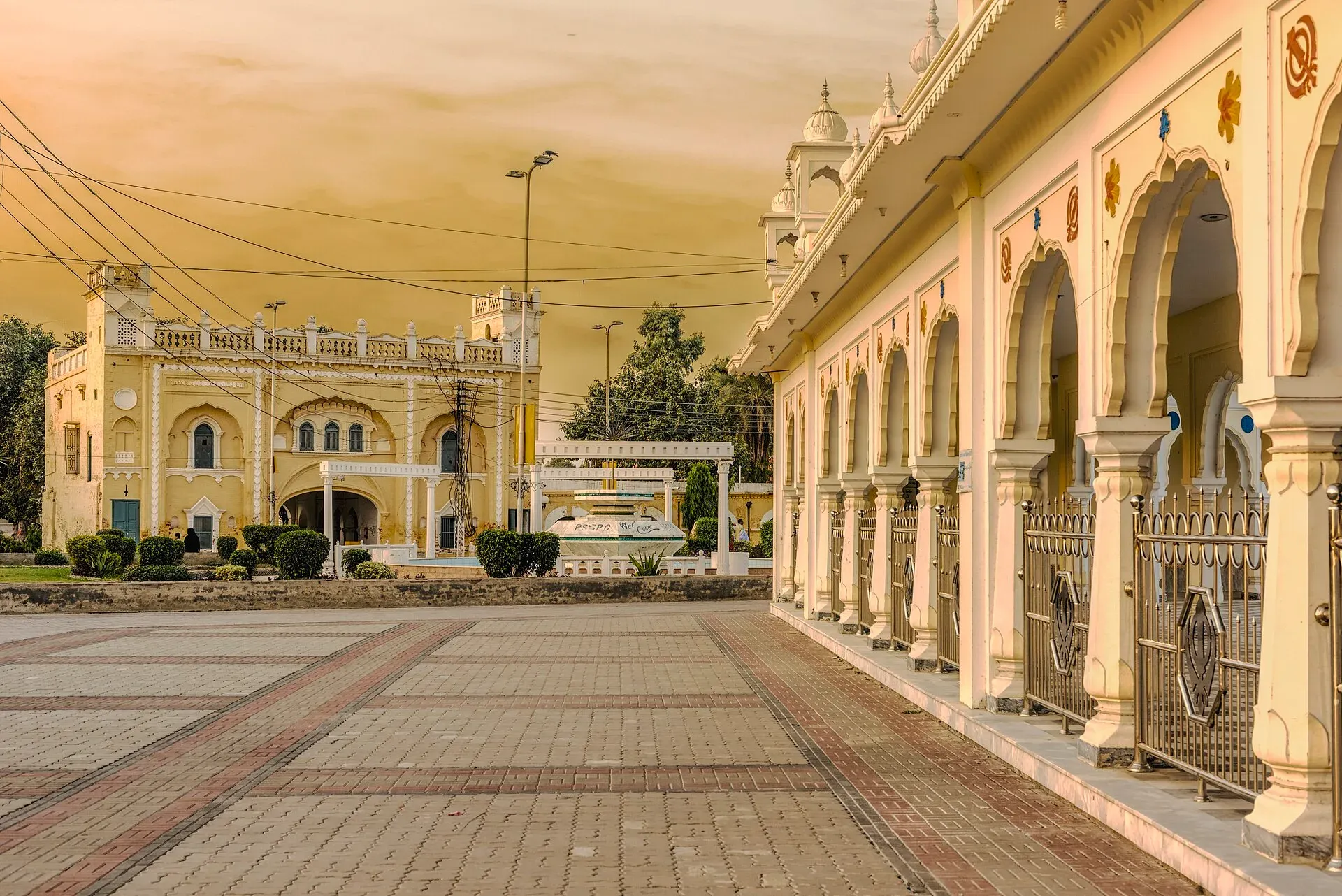
Photo: Shaguftakarim, with thanks · CC BY-SA 4.0 · via Wikimedia Commons · temporary stand-in photo

Hasan Abdal
Gurdwara Panja Sahib surrounds the spring and the rock with the handprint, beside the Grand Trunk Road near Taxila. Wikipedia says the water flows from behind the rock into a large pool, with fish visible under the handprint, and that the site's spring is identified with a spring the 7th-century Chinese traveller Xuanzang described near Taxila. The gurdwara is run by the PSGPC. An old Hindu temple stands behind it, and Wikipedia says an earlier building had murals of Guru Nanak's life.
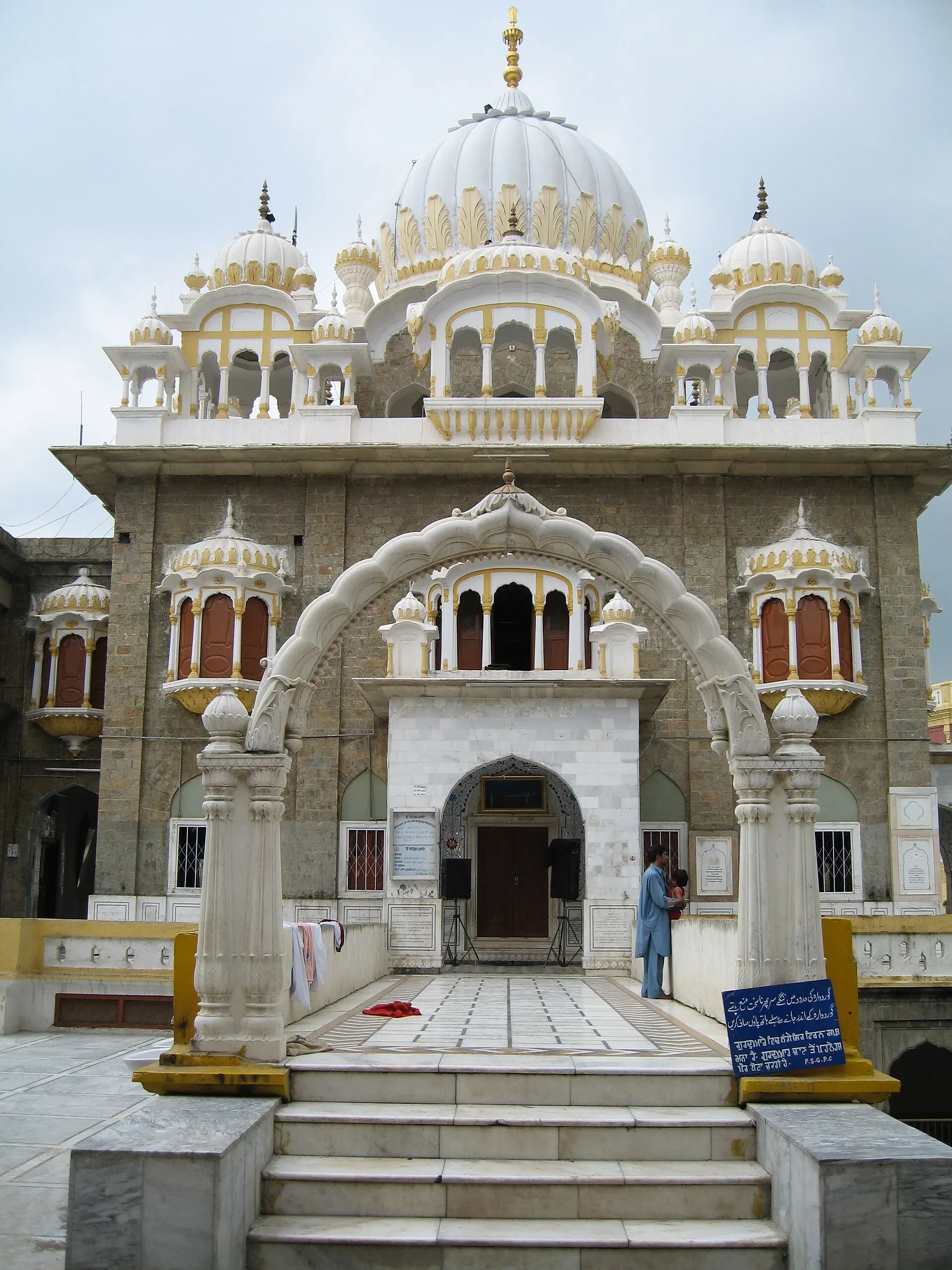
Photo: BookwormUK at English Wikipedia, with thanks · Public domain (CC0) · via Wikimedia Commons · temporary stand-in photo

Kartarpur
Gurdwara Darbar Sahib, near the Ravi in Narowal, lies about 3 to 4.7 km from the border (Wikipedia's pages give 3 km in one place and 4.7 km in another, and some sources say about 4 km) and is visible from India. The main shrine was begun in 1925 with funds from the Maharaja of Patiala, restored in 2004 and expanded in 2018 across 42 acres with a courtyard, museum and library. A brick well about 20 ft deep, with a Persian wheel known as Khue Sahib, is said to date from Guru Nanak's lifetime, though that rests on tradition. See the safety section: access is limited.
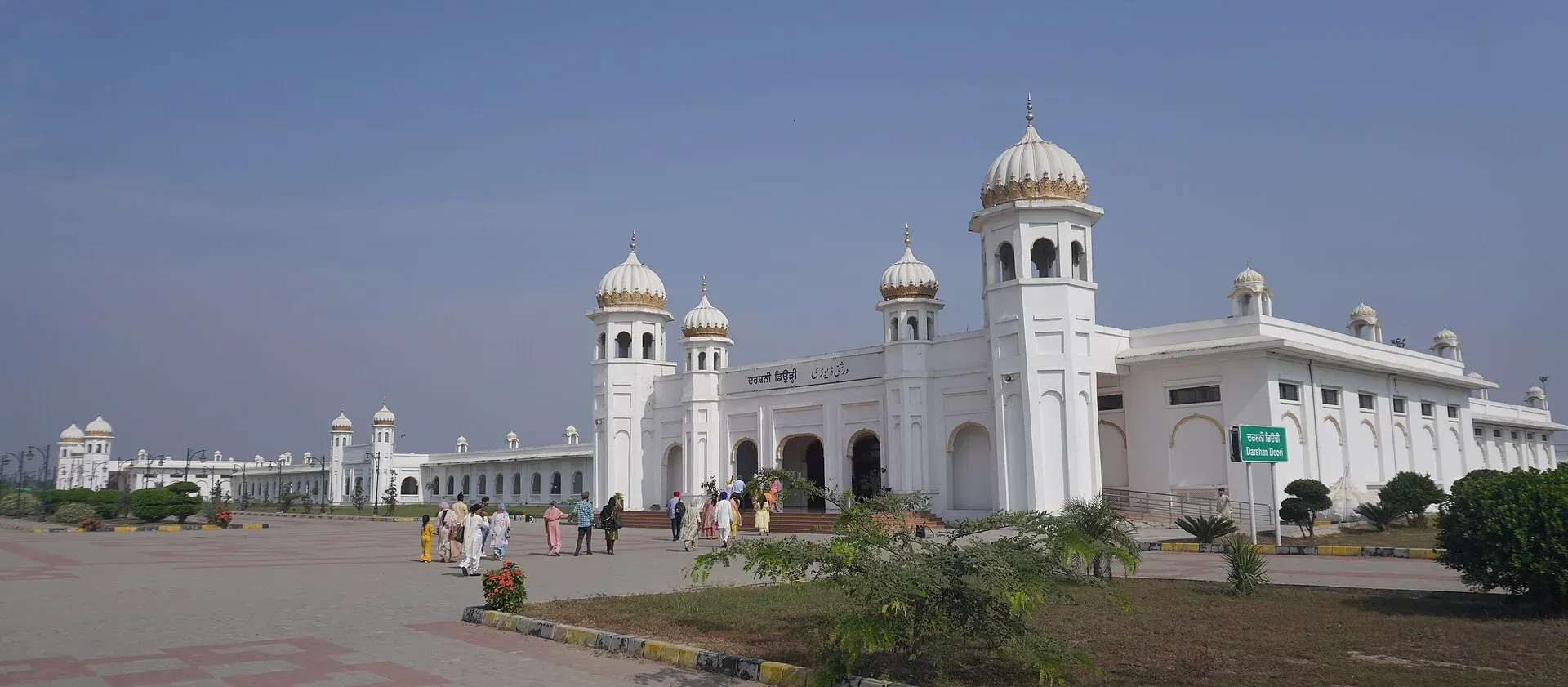
Photo: Harvinder Chandigarh, with thanks · CC BY 4.0 · via Wikimedia Commons · temporary stand-in photo

Etiquette in a gurdwara
Take your shoes off and cover your head. Scarves are usually provided at the door, but bring your own to be safe. Do not bring tobacco, alcohol or intoxicants. Dress modestly, sit on the floor and do not point your feet towards the Guru Granth Sahib. Ask before taking photographs. Langar, the free meal, is part of the worship, so take only what you will eat. Follow instructions from the PSGPC and ETPB staff. Visits to the Samadhi of Ranjit Singh are limited to local and visiting Sikhs, and others need special permission from the ETPB (Wikipedia, which gives no hours or fee), so ask in advance. There is no known ETPB page that sets out the permission process.
Pilgrim information
The ETPB manages Sikh pilgrim visits under the bilateral protocol on visits to religious shrines. It lists four annual gatherings, each with a quota and a 10-day stay:
- Baisakhi, Panja Sahib, Hasan Abdal: April, quota 3,000.
- Martyrdom Day of Guru Arjan Dev, Lahore: June, quota 1,000.
- Death anniversary of Maharaja Ranjit Singh, Lahore: June, quota 500.
- Birth anniversary of Guru Nanak, Nankana Sahib: November, quota 3,000.
Pakistan issued more than 2,800 visas for Baisakhi 2026, which ran from 10 to 19 April with the main ceremony on 14 April at Panja Sahib. Pilgrims from India enter through Wagah. The ETPB's Shrines Branch page lists the four gatherings by month only, with no dates, so 2027 dates and quotas are not yet confirmed; the 2027 Baisakhi and other dates will be added when announced. For the 557th birth anniversary the main ceremony is at Nankana Sahib on 24 November 2026, with pilgrims due at Wagah on 22 November. Sikhs living outside India and Pakistan should ask the nearest Pakistani mission about visas. The Kartarpur Corridor was visa-free for Indian Sikhs from 9 November 2019, but Wikipedia says India suspended its services indefinitely on 7 May 2025 and reports no reopening; there is no known 2026 notice of a reopening.
When to go
October to April suits the plains. The festival weeks bring crowds, heavy security and full accommodation, so book well ahead or choose a quiet week.
Entry fees
Fees may apply at Lahore Fort and some monuments; current fees will be added soon. Ask the PSGPC or ETPB about any charge at the gurdwaras.
Highlights
- Gurdwara Janam Asthan at Nankana Sahib, birthplace of Guru Nanak
- Gurdwara Panja Sahib at Hasan Abdal
- Samadhi of Maharaja Ranjit Singh beside Lahore Fort
- Gurdwara Darbar Sahib at Kartarpur, where Guru Nanak died in 1539
Stops
- Lahore: Samadhi of Ranjit Singh and Gurdwara Dera SahibNext to Lahore Fort and the Badshahi Mosque
- Nankana SahibGurdwara Janam Asthan
- KartarpurGurdwara Darbar Sahib; within 5 miles of the border; closed for crossings
- Hasan AbdalGurdwara Panja Sahib (OSRM: 387 to 393 km direct, 349 km via Islamabad; Islamabad to Hasan Abdal is 64 km)
km: distance from the start along the route.
Numbers follow the stops in order. The map shows the stops, not the road itself.
Day by day
Day 1 · Lahore: Ranjit Singh and the Walled City
See Lahore Fort (Ranjit Singh's residence), the Badshahi Mosque across the square and the Samadhi of Ranjit Singh and Gurdwara Dera Sahib beside them. The first two are 3 km apart by road. Ask the ETPB about access to the samadhi.
Day 2 · Lahore to Nankana Sahib and back
Drive 76 km west to Nankana Sahib (about 1 hour). Visit Gurdwara Janam Asthan and the other gurdwaras in the town, then return to Lahore (75 km). Early arrival helps; the langar hall is busiest at midday.
Day 3 · Lahore to Hasan Abdal
A long day on the motorway and Grand Trunk Road to Hasan Abdal, 393 km from Lahore by the OSRM route we first measured. A re-run on 16 November 2026 gave 387 km (about 4 h 20) direct and 349 km (about 4 h 30) by way of Islamabad, so the direct route is the faster but not the shorter one. Visit Gurdwara Panja Sahib in the late afternoon. Stay in Islamabad or Taxila (64 km or less), which has more hotels.
Day 4 · Optional: Kartarpur (from Lahore, not part of the main loop)
Kartarpur is 114 km from Lahore (1.9 hours by OSRM). It is within 5 miles of the India border, so the FCDO advises against all but essential travel there for ordinary visitors. Do this only after checking current advice with the ETPB and your embassy.
Road conditions
- Lahore to Nankana Sahib: paved main road; busy near town.
- Lahore to Islamabad: M-2 motorway, tolled.
- Islamabad to Hasan Abdal: motorway and highway.
- Times: OSRM drive times are optimistic and exclude stops, traffic and checkpoints.
- Festival weeks: expect diversions and security checks around the gurdwaras.
Fuel and services
Lahore, Nankana Sahib and Hasan Abdal have fuel, food and basic hotels. Gurdwaras serve free langar to visitors. Accommodation at festival times is arranged through the ETPB for pilgrims.
Where to stay, eat and fuel up
Places to stay
- Avari Towers KarachiCall Avari Towers KarachiMap of Avari Towers Karachi in Google Maps
- Pearl Continental Hotel, LahoreCall Pearl Continental Hotel, LahoreMap of Pearl Continental Hotel, Lahore in Google Maps
- Avari Hotel LahoreCall Avari Hotel LahoreMap of Avari Hotel Lahore in Google Maps
- Serena HotelCall Serena HotelMap of Serena Hotel in Google Maps
- Islamabad Marriott HotelCall Islamabad Marriott HotelMap of Islamabad Marriott Hotel in Google Maps
- Mövenpick KarachiCall Mövenpick KarachiMap of Mövenpick Karachi in Google Maps
Places to eat
- The Monal IslamabadCall The Monal IslamabadMap of The Monal Islamabad in Google Maps
- Tehzeeb Bakers Blue AreaCall Tehzeeb Bakers Blue AreaMap of Tehzeeb Bakers Blue Area in Google Maps
- TKR 3Call TKR 3Map of TKR 3 in Google Maps
- Port Grand - KarachiCall Port Grand - KarachiMap of Port Grand - Karachi in Google Maps
- Kolachi RestaurantCall Kolachi RestaurantMap of Kolachi Restaurant in Google Maps
- Savour FoodsCall Savour FoodsMap of Savour Foods in Google Maps
Essential services fuel stations, mechanics, banks, pharmacies and hospitals and clinics
Fuel
- PSO Petrol Pump (Stadium Service Station)Call PSO Petrol Pump (Stadium Service Station)Map of PSO Petrol Pump (Stadium Service Station) in Google Maps
- Attock Petrol PumpMap of Attock Petrol Pump in Google Maps
- PSO Petrol PumpMap of PSO Petrol Pump in Google Maps
- PSO Petrol PumpMap of PSO Petrol Pump in Google Maps
- Total Parco LA TownCall Total Parco LA TownMap of Total Parco LA Town in Google Maps
- PSO-Al-Rafay Filling Station - Petrol Pump Thokar Niaz BaigCall PSO-Al-Rafay Filling Station - Petrol Pump Thokar Niaz BaigMap of PSO-Al-Rafay Filling Station - Petrol Pump Thokar Niaz Baig in Google Maps
Mechanics and tyre shops
- Mohammed Bilal tyre centreMap of Mohammed Bilal tyre centre in Google Maps
- Changan City SalesCall Changan City SalesMap of Changan City Sales in Google Maps
- Toyota Airport MotorsCall Toyota Airport MotorsMap of Toyota Airport Motors in Google Maps
- Honda GatewayCall Honda GatewayMap of Honda Gateway in Google Maps
- Saif Traders - Best Tyre Shop in LahoreCall Saif Traders - Best Tyre Shop in LahoreMap of Saif Traders - Best Tyre Shop in Lahore in Google Maps
- Mini MotorsCall Mini MotorsMap of Mini Motors in Google Maps
Banks and money exchange
- State Bank of PakistanCall State Bank of PakistanMap of State Bank of Pakistan in Google Maps
Pharmacies
- Al Jadeed Super MarketCall Al Jadeed Super MarketMap of Al Jadeed Super Market in Google Maps
- Imtiaz Mega - Ramzan Mall - islamabadCall Imtiaz Mega - Ramzan Mall - islamabadMap of Imtiaz Mega - Ramzan Mall - islamabad in Google Maps
- Imtiaz Supermarket - Awami Markaz - KHICall Imtiaz Supermarket - Awami Markaz - KHIMap of Imtiaz Supermarket - Awami Markaz - KHI in Google Maps
- Imtiaz Mega - Kings Mall - GujranwalaCall Imtiaz Mega - Kings Mall - GujranwalaMap of Imtiaz Mega - Kings Mall - Gujranwala in Google Maps
- Hydri Super MarketCall Hydri Super MarketMap of Hydri Super Market in Google Maps
- Raja Market Garden Town LahoreCall Raja Market Garden Town LahoreMap of Raja Market Garden Town Lahore in Google Maps
Hospitals and clinics
- Hashmanis Hospital NumaishCall Hashmanis Hospital NumaishMap of Hashmanis Hospital Numaish in Google Maps
- Holistic CareCall Holistic CareMap of Holistic Care in Google Maps
- Lahore Care HospitalCall Lahore Care HospitalMap of Lahore Care Hospital in Google Maps
- Shifa International Hospitals LimitedCall Shifa International Hospitals LimitedMap of Shifa International Hospitals Limited in Google Maps
- Amanat Eye Hospital RawalpindiCall Amanat Eye Hospital RawalpindiMap of Amanat Eye Hospital Rawalpindi in Google Maps
- Maryam Memorial Hospital (MMH)Call Maryam Memorial Hospital (MMH)Map of Maryam Memorial Hospital (MMH) in Google Maps
Listings come from Google Maps data and are unverified: phone numbers, opening months and prices may have changed. Report a problem · Own one of these? Claim it
Safety
- Government advice (UK FCDO, updated 27 October 2026, checked 16 November 2026): the FCDO advises against all but essential travel within 5 miles of the India border. The exceptions are the Grand Trunk highway via Wagah (the crossing point is closed, but the daily Wagah ceremony can still be attended) and the Kartarpur Corridor for Sikh pilgrims (closed for crossings). It does not name Lahore, Nankana Sahib or Hasan Abdal.
- Kartarpur: about 3 to 4.7 km from the border, so it falls inside the 5-mile zone. Only the corridor for Sikh pilgrims is an exception, and the corridor is closed.
- Ask the district administration or local police about current conditions before you go. Karakoram Highway: For foreign visitors: the UK FCDO advises against all travel on the KKH between Mansehra and Chilas, which affects onward trips north of Hasan Abdal.
- Insurance: travel insurance can be invalid if you travel against FCDO advice.
- Crowds and security: festival times bring heavy security and some road closures. Carry your passport or CNIC and follow instructions at checkpoints.
Tips
- Cover your head and remove your shoes at every gurdwara.
- Book ahead for Baisakhi (April) and the November birth anniversary.
- Ask the ETPB before you plan a visit to the Samadhi of Ranjit Singh.
- Kartarpur is within 5 miles of the India border, so check current advice first.
Sources and last checked
Last checked Confidence medium13 sources5 still to check
- Last checked
- Method
- Desk research from published sources
- Confidence
- medium
- Checked by
- trek.pk research team
Researched from published sources; not yet checked on the ground by our team. Spot something out of date? Report a mistake.
Sources
- Pakistan travel advice: Warnings and insurance (updated 27 October 2026) · UK Foreign, Commonwealth & Development Office (FCDO) · checked
- OSRM driving route service: distances and times measured 16 November 2026 (drive times are optimistic and exclude stops) · OSRM / OpenStreetMap contributors · checked
- Shrines Branch: pilgrim festivals, quotas and stay · Evacuee Trust Property Board (ETPB) · checked
- Pakistan issues visas to 2,800 Sikh pilgrims from India for Baisakhi festival · Dawn · checked
- Arrangements for 557th birth anniversary of Baba Guru Nanak finalised (16 October 2026) · The Nation · checked
- Sikhism in Pakistan (Wikipedia) · Wikipedia · checked
- Kartarpur Corridor (Wikipedia) · Wikipedia · checked
- Gurdwara Janam Asthan (Wikipedia) · Wikipedia · checked
- Gurdwara Panja Sahib (Wikipedia) · Wikipedia · checked
- Gurdwara Darbar Sahib Kartarpur (Wikipedia) · Wikipedia · checked
- Samadhi of Ranjit Singh (Wikipedia) · Wikipedia · checked
- Lahore Fort (Wikipedia) · Wikipedia · checked
- Nankana Sahib (Wikivoyage) · Wikivoyage · checked
Still to be checked on the ground (5)
- The ETPB process and any fee for non-Sikh visitors to the Samadhi of Ranjit Singh (Wikipedia says special ETPB permission is needed; no official page found)
- Whether the Kartarpur Corridor is open (suspended by India on 7 May 2025; no reopening found) and the Wagah crossing for non-pilgrims (pilgrims were due via Wagah on 22 November 2026 per The Nation)
- Dates and quotas for the 2027 gatherings (ETPB page gives months and quotas only; no 2027 dates)
- Distance of Gurdwara Darbar Sahib from the India border: Wikipedia 4.7 km, other sources about 3 to 4 km
- Whether the Sikh gurdwara spring at Panja Sahib is identical with the spring described by Xuanzang (Wikipedia says it is identified with it; no scholarly source opened)
Nearby and related

Lahore
Punjab's capital and Pakistan's cultural city: Mughal forts, mosques and gardens, a lively Walled City, and some of the best food in the country.

Badshahi Mosque
Lahore's great Mughal mosque, built for Emperor Aurangzeb in 1671-73 from red sandstone and marble. It faces Lahore Fort and has been on UNESCO's tentative list since 1993.

Gurdwara Janam Asthan (Nankana Sahib)
The gurdwara at Nankana Sahib marking the birthplace of Guru Nanak, founder of Sikhism, about 65 km from Lahore. One of the holiest Sikh sites. Visitor access rules vary, so check before you go.

Gurdwara Panja Sahib (Hasan Abdal)
A Sikh shrine in Hasan Abdal where a handprint on a boulder is believed to be Guru Nanak's, beside a spring that never dries. About 64 km from Islamabad. Check access rules before you go.

Kartarpur Sahib
The gurdwara where Guru Nanak is said to have spent his last 18 years, beside the Ravi in Narowal District, close to the Indian border. The Kartarpur Corridor has been closed from India's side since May 2025.

Walled City of Lahore
Lahore's old core: lanes, gates and Mughal and Sikh-era monuments around the Royal Road, including Wazir Khan Mosque, Delhi Gate and the Shahi Hammam. Its lanes are best explored on foot.

Islamabad
Pakistan's green, planned capital at the foot of the Margalla Hills: Faisal Mosque, hillside trails, cafes and the gateway to the north.

Wazir Khan Mosque
A Mughal mosque in Lahore's Walled City, built 1634 to 1641, famous for its tilework and painted interior. On Pakistan's UNESCO tentative list since 1993, and still an active place of worship.

Lahore Heritage and Wagah
A two to three day city trip: Lahore Fort, the Badshahi Mosque and old city, the Shalimar Gardens, and the evening flag-lowering at Wagah, 33 km from the fort. Measured distances and current notes on the new Wagah arena.