

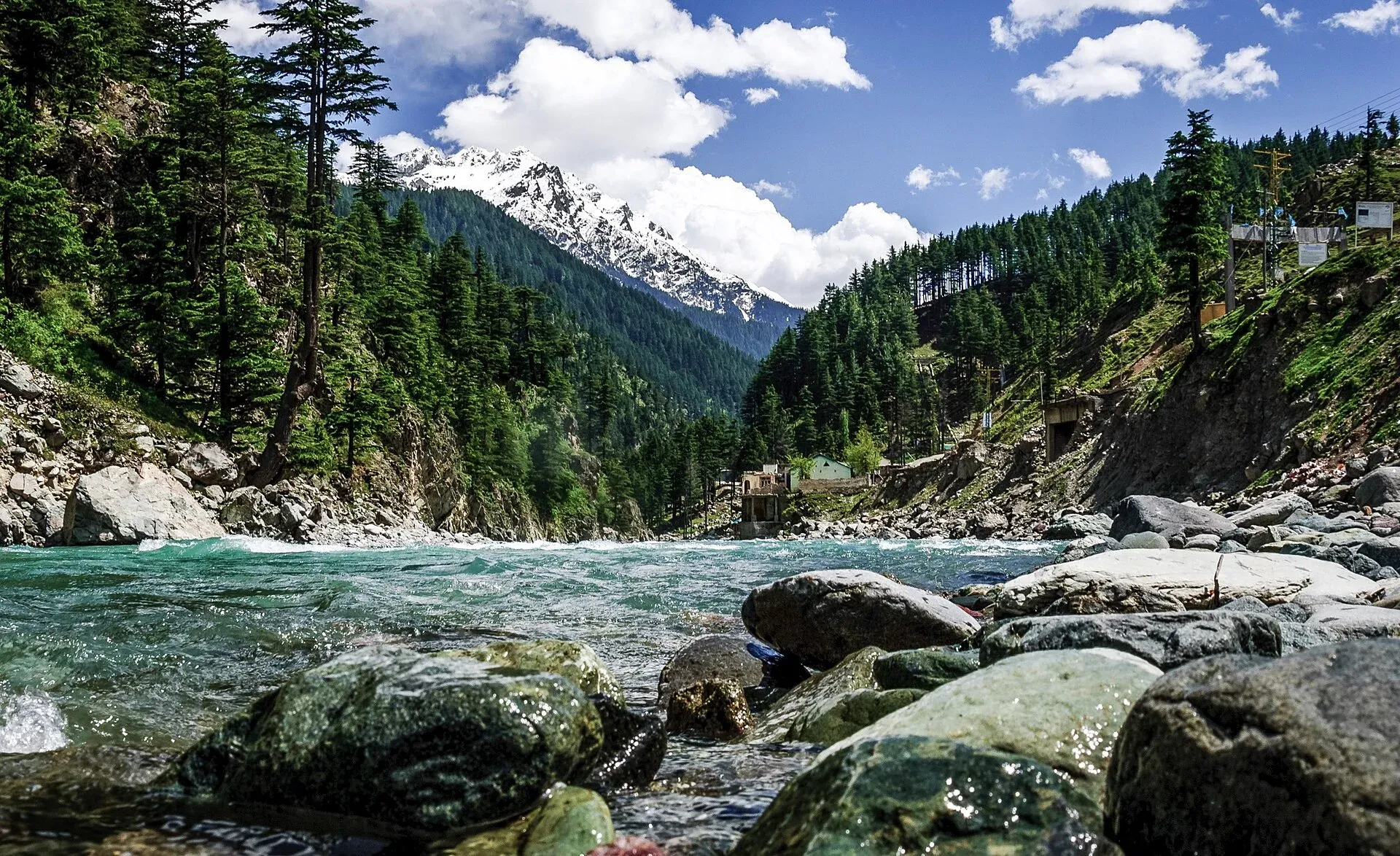
Photo: Designer429, with thanks · CC BY-SA 3.0 · via Wikimedia Commons · temporary stand-in photo

Swat Valley
A long green river valley in northern Khyber Pakhtunkhwa, with Gandhara Buddhist sites, orchards, hill towns and the road up to Kalam. Check the current security advice before you plan a trip.
Overview
The Swat Valley follows the Swat River for about 210 km, from the glacier-fed headwaters near Kalam down to the plains near Chakdara. Wikipedia gives the valley an average elevation of about 980 m, so it is cooler and wetter than most of Pakistan. The lower valley is broad farmland. The upper valley narrows into pine forest and steep side valleys.
Swat is also one of the richest places in Pakistan for early Buddhist history. In ancient texts it appears as Oddiyana, and the Chinese pilgrim Faxian, who passed through around 403 CE, wrote of hundreds of monasteries. Stupas, rock carvings and monastery ruins still stand in the fields and on the hillsides. The valley was a princely state until it was merged with Pakistan in 1969.
Plan your visit
- Nearest town
- Mingora
- Getting there
By road from Islamabad via Mardan and the Malakand Pass to Mingora (OSRM about 233 km, 2.8 h; real times are longer), then north to Kalam (about 95 km by OSRM). Buses and vans run from Peshawar and Rawalpindi. More
Best months
Apr – Oct
- Swat Valley
- Related places nearby: Kalam, Utror and Gabral, Saidu Sharif, Mahodand Lake, Kundol Lake, Izmis Lake, Madyan, Bahrain, Miandam (Swat), Barikot (ancient Bazira), Swat, Chakdara Fort, Tirat Valley, Karakar Pass, Mingora, Kabal, Matta
Getting there
Most visitors come by road from Islamabad through Mardan and the Malakand Pass to Mingora, the main town. OSRM puts Islamabad to Mingora at about 233 km and 2.8 hours, and Mingora to Kalam at about 95 km and 1.2 hours. OSRM times are optimistic. Allow 4 to 5 hours from Islamabad to Mingora on a busy day, and 3 to 4 hours more to Kalam, especially at weekends and at Eid, when traffic is heavy. Wikipedia lists Kalam as 99 km from Mingora.
Public transport runs from Peshawar and Rawalpindi to Mingora, with minibuses and shared vans on up the valley. The valley has no passenger rail line.
Villages and sights
- Mingora and Saidu Sharif. The valley's main town and the old capital of the princely state. The archaeological museum at Saidu Sharif holds Gandhara sculpture from Swat.
- Butkara, Amluk-Dara and other Buddhist sites. Stupas and monastery foundations lie close to Mingora and across the valley. Restored sites include the large rock-cut Buddha at Jehanabad, whose face was damaged by militants and later repaired by restorers.
- Udegram and Raja Gira castle. Ruins from the Hindu Shahi period, on the hills above the river.
- Swat Museum. Between Mingora and Saidu Sharif, with seven galleries of Gandhara sculpture and ethnographic displays, according to Wikivoyage (undated; check that it is open).
- Miandam. A summer resort in a side valley, about 56 km from Saidu Sharif and roughly an hour's drive, with walks and carved wooden grave posts in its graveyards (Wikivoyage).
- Madyan. Riverside bazaars, trout restaurants and hotels, at about 1,320 m and some 60 km from Mingora. Wikivoyage calls it the last Swati village and notes carved wooden pillars in its central mosque. It is the base for walks of two to three days.
- Bahrain. About 10 km above Madyan at about 1,400 m, known for woodcarving, including carved doors and balconies. It is where the road splits for Kalam.
- Malam Jabba. A hill station and ski area about 40 km from Saidu Sharif, with a resort owned by the Pakistan Tourism Development Corporation. The top station is at about 2,800 m. Wikipedia says the original chairlift was burned in June 2008 and a new 800 m chairlift was inaugurated in September 2016, and that a private company rebuilt the resort, including a 76-room Pearl-Continental hotel opened in 2020. There are no known current operating dates, so check before you go.
- Kalam, Utror, Gabral and Ushu. The high valleys at the head of the river, described on their own page.
One or two days in the valley
An outline built from the sights above. A first day in the lower valley can take in the Swat Museum, the Buddhist sites near Mingora and Saidu Sharif, and Udegram, with an evening in Mingora. A second day runs up the valley through Miandam, Madyan and Bahrain towards Kalam, and needs an early start in summer. Malam Jabba is a separate day trip from Saidu Sharif.
Treks and walks
Most walks here are lake and meadow routes from Kalam, such as the Izmis Lake Trail. Longer crossings lead north to Chitral, such as Kachakani An from Mahodand to Sor Laspur. These are on the Kalam page and in the trek section. Ask a local guide before leaving the road, as snow and flooded streams are common even in summer.
When to visit
April to October is the main season. Spring brings blossom and green slopes. July and August are warm in the lower valley and pleasant above Madyan, but also the busiest and wettest, with a risk of landslides and sudden river rises. Autumn colours arrive in October. Wikivoyage describes the road beyond Bahrain as snowbound from December to March. The ski area opens in snowy winters, usually January to February, when heavy snow can close the upper road.
Where to stay and eat
Mingora, Madyan, Bahrain and Kalam have the widest choice, from basic guest houses to mid-range hotels. Book ahead for Eid and for July and August weekends. Food is mostly Pashtun and Swati: roasted meat, rice dishes, freshwater trout in Madyan and Bahrain, and local fruit and honey.
Food and crafts
Wikivoyage lists trout dishes in Madyan, karahi, kebabs and paye (trotters) as common meals, with plums, apricots and peaches in season. Drinks include noon chai (the pink, salted Kashmiri tea), Swati lassi and buttermilk. Swat is known for emeralds, for embroidered shawls from Madyan, and for carved-wood furniture from Bahrain. Marble utensils, tribal jewellery and handmade carpets are also on sale in the bazaars.
Culture and languages
The lower valley is mainly Pashtun, and Pashto is the main language. Further up the valley, Torwali and Gawri are spoken, and Gujari is spoken by the Gujar herding families. Urdu is understood everywhere. Dress modestly, especially in smaller villages, and ask before photographing women or private homes.
Safety and practical points
- Security advice. The UK Foreign Office (FCDO) advises against all travel to Swat, in advice last updated on 27 October 2026 and checked on 16 November 2026. Swat was held by the Pakistani Taliban from 2007 to 2009 before the army retook it. Visitors from Pakistan travel in large numbers, but you should read the current advice for your own government and ask local sources before going.
- Water safety. After a sudden rise in the Swat River in June 2025 swept away a group of tourists, an official inquiry called for river rules, warning signs and monitoring (Aaj News, July 2025); check locally for any current restrictions. Do not wade or sit on riverbeds, especially in monsoon months. A tourist boat on Kalam's Saifullah Lake capsized on 1 July 2026. The News reported seven drowned and two rescued, after earlier counts of five bodies recovered and four tourists missing; other reports may differ, so treat the toll as reported, not final. Use only licensed operators and life jackets.
- Crowds. At Eid the roads above Madyan are slow and hotels fill. Plan to arrive early.
- Tourism police and emergencies. Rescue 1122 operates across Khyber Pakhtunkhwa. Check the number with your hotel.
Highlights
- Gandhara Buddhist stupas and monasteries around Mingora
- Swat River with trout restaurants at Madyan and Bahrain
- Malam Jabba hill station and ski area
- Gateway to Kalam, Utror and Gabral
- Long history as Oddiyana and a princely state
Tips
- Check the security advice for your country before you go.
- Do not swim or wade in the Swat River; levels can rise very fast.
- Avoid Eid and July weekends if you want quiet roads.
- Use licensed boat operators and wear a life jacket on lakes.
Photos we still need: Swat food or a bazaar (Food and crafts); Swat Museum building. Send us yours
Sources and last checked
Last checked Confidence medium8 sources5 still to check
- Last checked
- Method
- Desk research from published sources
- Confidence
- medium
- Checked by
- trek.pk research team
Researched from published sources; not yet checked on the ground by our team. Spot something out of date? Report a mistake.
Sources
- Swat Valley (Wikipedia) · Wikipedia · checked
- Malam Jabba (Wikipedia) · Wikipedia · checked
- Swat River boat tragedy: inquiry report exposes police negligence · Aaj News · checked
- Seven drown as tourist boat capsizes in Swat's Saifullah Lake · The News · checked
- Pakistan travel advice (last updated 27 October 2026) · UK FCDO · checked
- Pakistan Tourism Guide 2021 · TDAP · checked
- OSRM routing (Islamabad-Mingora-Kalam) · Project OSRM · checked
- Swat Valley (Wikivoyage) · Wikivoyage · checked
Still to be checked on the ground (5)
- Current tourist-police and river-safety rules (Aaj, 26 Jul 2025: inquiry into the June 2025 river tragedy found police negligence and recommended a regulatory system, enforced Section 144, signboards and monitoring; it does not describe an enacted ban, and no 2026 rules were found)
- Malam Jabba lift and resort opening season (Wikipedia: new chairlift 2016, Pearl-Continental hotel 2020; no current season found)
- Exact road times, which depend on traffic and weather (OSRM figures only)
- Toll of the July 2026 Saifullah Lake boat accident: The News (1 Jul 2026) says seven dead, two rescued; no second source opened
- Swat Museum opening status (Wikivoyage, undated, says the army occupied it for a time; no current notice found)
Nearby and related

Izmis Lake Trail

Kachakani An

Kalam, Utror and Gabral
The head of the Swat valley: Kalam town where the Ushu and Gabral rivers meet, with Ushu forest, Utror and Kundol Lake, Gabral, and jeep tracks to Mahodand Lake.

Saidu Sharif
The administrative town of Swat, joined to the bazaar city of Mingora, with the ancient Butkara stupa, the Swat Museum of Gandhara art, a Sufi shrine and the road into the Swat valley.

Mahodand Lake
A cold trout lake at about 2,865 m in the Usho valley above Kalam, reached by a rough 4x4 track of around 40 km. Open in summer only.

Kundol Lake
A glacial lake at about 3,030 m above Utror in Swat, reached by a 4x4 track to Ladu and then a hike of around four to six hours.
Izmis Lake
A high glacial lake above the tree line, south-west of Utror in Swat. A jeep track ends at Loypanrghalay and the lake is a 3 to 6 hour walk beyond.

Khyber Pakhtunkhwa
Mountains, Buddhist ruins and old bazaars in north-west Pakistan: Swat, Kaghan, Chitral, the Kalash valleys, the Khyber Pass and Peshawar.

Madyan
Madyan is a riverside town at about 1,320 m in upper Swat, KP, home to Torwali people, known for trout and as the base for Bashigram Lake and Malam Jabba. For foreign visitors: the UK FCDO advises against all travel to Swat.

Bahrain
A riverside town at about 1,432 m in Upper Swat, at the meeting of the Daral and Swat rivers, known for riverside guesthouses, crafts and the trail to Daral and Saidgai lakes.
Miandam (Swat)
A summer resort in a side valley of Swat, about 55 km from Mingora, known for forest, cool air and quiet.
Barikot (ancient Bazira), Swat
The excavated ancient city of Bazira beneath Barikot in the Swat valley, dug by an Italian-Pakistani team since 1984. Includes an early Buddhist temple, an Indo-Greek wall and a site that Alexander's army besieged. On Pakistan's UNESCO tentative list since 2026.
Chakdara Fort
A British fort of 1896 on the site of an older Mughal fort at Chakdara, Lower Dir, famous for its defence in the siege of 26 July to 2 August 1897. It is used by the Chitral Scouts. In an area the UK FCDO advises against visiting.
Tirat Valley
A village and union council in Upper Swat, about 3 km from Madyan, with pine and deodar forest and a mosque minaret as its landmark. FCDO advises against all travel in Swat.
Karakar Pass
A road pass of about 1,336 m between Swat and Buner, on the Pir Baba to Barikot road. Known for the Mughal defeat of 1586. FCDO advises against all travel to Swat and Buner.

Mingora
Largest city of the Swat Valley on the Swat River, about 984 m up, with 361,112 people at the 2023 census. The usual base for Saidu Sharif, the Swat Museum and Buddhist sites.
Kabal
Town and tehsil of Swat District about 10 km from Mingora, with 132,549 people at the 2023 census.
Matta
The main town of Matta tehsil in the Swat Valley, on the way to Chatekal and Jarogo Waterfall. UK advice is against all travel to Swat.